A thin crescent hangs in the sky. A few nights later, more of the Moon is showing. Where did the rest of it go, and what brought it back? It is a lovely question to bring to the Moon Lantern: a small observatory where you can move the Moon yourself and watch its appearance change.
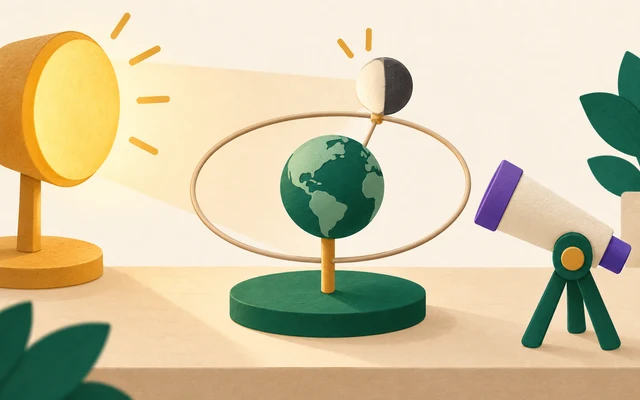
The lab gives you two views at once. On the main stage, a sun lamp shines towards Earth and the Moon. Beside it, a telescope shows the Moon as seen from Earth. Move the Moon around its orbit and compare those views. The round Moon stays round; the bright shape in the telescope changes.
Follow the light
The Moon reflects sunlight. During its ordinary phases, the Sun lights half of it, while the other half faces away from the Sun. As the Moon travels around Earth, we see different amounts of that sunlit half. A crescent, a half Moon and a full Moon are different views of the same round object.
At full Moon, the side facing us is lit. At new Moon, that side faces away from the Sun. The familiar monthly phases are not caused by Earth’s shadow covering the Moon; that shadow matters during a lunar eclipse. The lab is a simplified view of the arrangement, rather than an eclipse predictor.
NASA explains why we see Moon phases →
Try it: predict, move, compare
Before moving anything, point to the sun lamp. Predict where you would place the Moon to make the telescope show a full, bright circle. Then test that idea:
- Move: drag the Moon around Earth until the phase reads Full. If it is moving by itself, press Hold still first. Look at both the stage and telescope, then note the Lit part reading. It should be close to 1: almost all of the visible disc is bright.
- Change: predict what the telescope will show when the Moon is on the lamp’s side of Earth. Drag it there and look for New. Compare the telescope and Lit part reading with your first observation; the reading should now be close to 0.
- Explain: point to the part of the Moon receiving light in each position. How can the lamp still illuminate half of the Moon while the telescope shows so little of it? Use the two views to explain your answer.
Watch the shapes connect
Now press Let it orbit. Lower Speed if you want more time to watch. Follow the telescope through a crescent, a half Moon, a fuller shape and a full Moon, then watch the bright part shrink again. Press Hold still whenever you want to compare a shape with the Moon’s position. Light rays switches the guide lines on or off, so you can choose the clearer view.
For a learner exploring with an adult, leave room for a guess before offering an explanation. Ask, “What do you think we will see next?” Then let the learner move the Moon and describe what changed. The useful part is connecting a prediction with something they can point to and explain.
Continue with The Moon, the Primary Science lesson linked below. Bring one question from the lab: why can a Moon that is still receiving sunlight look almost completely dark from Earth?