Here is a claim that sounds wrong: forgetting is not the enemy of learning. A little bit of it, at the right moment, is exactly what makes a memory durable. The trick is to bring an idea back just as it's starting to slip — not before, not long after. That single timing decision is the whole science of spaced repetition, and it's why Scolavo schedules quiet recap reviews instead of letting you cram and move on.
Ebbinghaus and the shape of forgetting
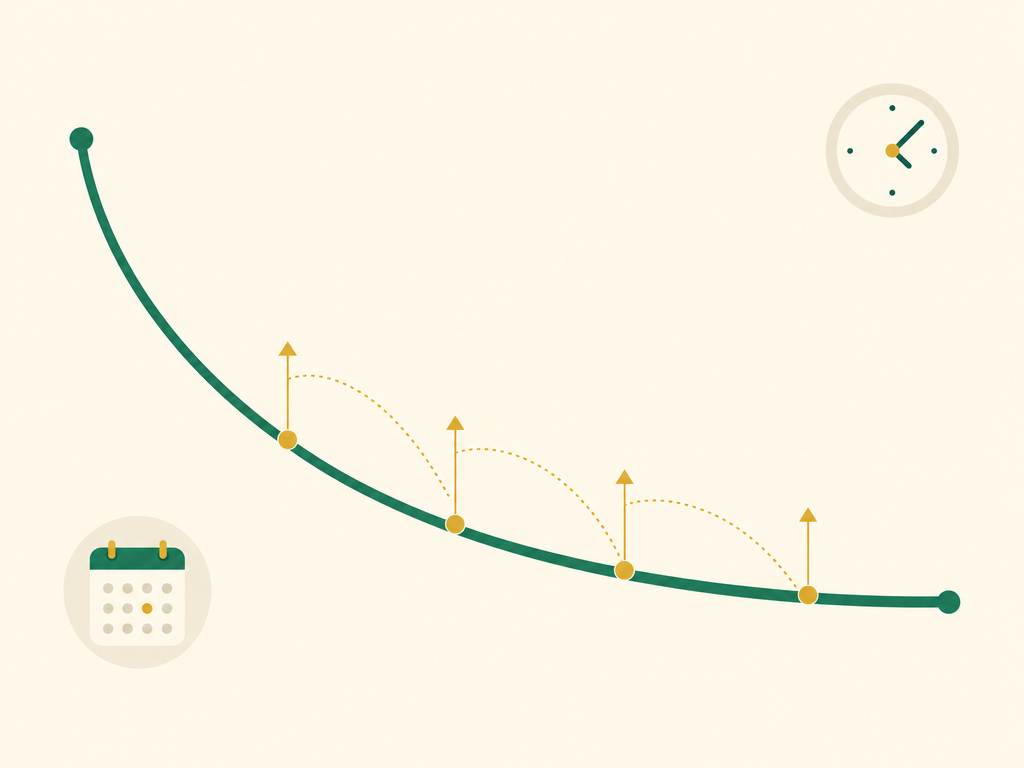
In the 1880s a German psychologist named Hermann Ebbinghaus did something slightly mad: he memorized long lists of nonsense syllables — wid, zof, kel — and then tested himself at intervals to measure how fast he forgot them. Using nonsense was deliberate; it stripped out prior knowledge so he could see memory's raw decay. What he found became the forgetting curve: retention drops steeply at first, then levels off. A large share of freshly learned material is gone within a day if nothing touches it again.
The exact percentages from his self-experiments don't transfer cleanly to a kid learning fractions — real, meaningful material with context decays far more slowly than nonsense syllables. But the shape is robust and has been replicated for over a century: memory leaks, fastest right after you learn, and the leak is normal, not a personal defect.
The part Ebbinghaus also found — and most people skip
The famous curve is only half the story. Ebbinghaus also measured what happened when he relearned a list: each repetition made the next round of forgetting slower and flatter. Bring the material back and the curve doesn't just reset — it bends. After a few well-timed reviews, a memory that used to fade in a day can hold for weeks or months.
The spacing effect: same minutes, much more memory
This is one of the most reliable findings in all of psychology. Take a fixed amount of study time. Pack it into one block (massed practice, a.k.a. cramming) or spread it across several sessions with gaps between them (spaced practice). Spaced wins, often by a lot, especially on tests given days or weeks later — the timeframe that actually matters for real learning.
The reason ties directly back to the forgetting curve. When you review while the memory is still fresh and easy, retrieval is effortless and teaches the brain almost nothing. When you wait until it's gone a little fuzzy, pulling it back is effortful — and that effort is the signal that tells your brain this is worth keeping. Cramming feels productive precisely because it's easy, which is exactly why it doesn't last.
How a scheduler decides when to bring something back
If forgetting-a-little is the sweet spot, the practical question is: when, exactly? The classic answer is expanding intervals. Review something today, then in a couple of days, then a week, then a few weeks, then a month or two — stretching the gap each time it survives. The SM-2 algorithm, the engine behind flashcard tools like Anki, formalizes this. Each item carries an interval and an ease factor; answer well and the gap multiplies (typically by an ease factor around 2.5), so 6 days becomes about 15, then around 38, and on out. Answer poorly and the item resets to a short interval to be relearned.
The elegant part is that the schedule is personal and per-item. The capital of France and the quadratic formula don't decay at the same rate for the same person, so they shouldn't be reviewed on the same clock. A good scheduler tracks each idea separately and surfaces it right around the moment it's predicted to start slipping — chasing that productive difficulty instead of wasting your time on what's still solid.
Interleaving: don't review one thing at a time
There's a companion technique that's easy to get wrong. Blocked practice means doing all of topic A, then all of topic B, then all of C. Interleaving means mixing them: A, C, B, A, B, C. Blocked practice feels smoother and more confident in the moment — and that's the trap. Interleaving consistently produces better retention and, crucially, better transfer.
Why? Because real problems don't announce their type. When math problems are blocked, you already know to use the chapter's method before you read the question; you're practicing execution, not selection. Interleaved, you first have to figure out which approach even applies — which is the skill you actually need on a test or in life. In one well-known study, students who interleaved different kinds of math problems massively outperformed blockers on a delayed test, even though the blockers felt more competent while practicing.
Why this all feels worse — and works better
- Spaced practice feels harder than cramming because you've forgotten a little and have to dig — that digging is the learning.
- Interleaving feels messier than blocking because you keep switching gears — that switching builds the ability to choose the right tool.
- Confidence during study is a famously poor predictor of actual retention; the easy, fluent feeling of massed, blocked practice is the very signal that it isn't sticking.
- These are called desirable difficulties for a reason: the friction is the feature, not a bug to optimize away.
How Scolavo schedules recaps instead of cramming
Most platforms treat a lesson as done the moment you finish it. We treat finishing as the start of a memory's life, not the end. When you complete a Scolavo lesson and its quiz, that material enters a review schedule rather than vanishing into a checkmark. Days later — then weeks later — short recap reviews resurface the key ideas: not the whole film again, but the handful of points that carry it, delivered as quick retrieval checks timed to land just as the forgetting curve predicts you'd start to slip.
How you do on a recap feeds the schedule, SM-2 style. Nail it and that idea moves further out, so we stop bothering you about things you clearly own. Stumble and it comes back sooner, relearned before it's fully gone. And because mastery tracking is per-learner and saved to your account, the schedule follows you across devices — your phone on the bus knows what your laptop taught you last week. Across a subject, recaps from earlier lessons naturally interleave with new ones, so you're mixing topics the way the research says you should without having to plan it.
What to take from this
If you remember one thing: don't measure a study session by how smooth it felt. Smooth usually means easy, and easy usually means it won't last. The durable stuff is built by spacing your practice out, mixing your topics up, and letting yourself forget just enough that bringing the idea back takes a little effort. You don't have to engineer that schedule by hand — that's a job we're happy to do quietly in the background. Your job is the more interesting one: staying curious enough to keep coming back.